Your Hair Is Only as Healthy as Your Scalp — A Vancouver Stylist’s Honest Guide
Most people walk into the salon talking about their hair. In nine years behind the chair — trained at the prestigious Aube Hair Academy in Tokyo and now working with clients daily at Salon Era in Vancouver — I’ve learned to listen for what they’re not saying: that the real issue almost always starts somewhere else.
It starts at the scalp.
Here’s the analogy I keep coming back to. Your scalp is soil. Your hair is the plant growing from it. You can use the most expensive shampoo, layer on every serum and mask you can find — but if the soil is unhealthy, the plant struggles regardless. No amount of surface-level care fixes a root problem.
9+
Years Behind the ChairTokyo
Aube Academy TrainedBilingual
EN | 中文Senior Hair Stylist & Scalp Specialist
Salon Era — Vancouver, BC
“The real issue almost always starts somewhere else. It starts at the scalp. And once you understand that, everything about caring for your hair changes.”
When Small Scalp Problems Are Actually One Big Signal
Persistent itchiness. A scalp that feels oily just a few hours after washing. A faint odour that keeps coming back. Dandruff that changes with the seasons regardless of what shampoo you try.
Most people treat these as separate, unrelated nuisances — something to manage rather than solve. In my experience, they’re almost always the same thing: a scalp environment that’s been knocked out of balance and is looking for attention.
That’s the conversation I end up having with more clients than you’d expect. And it’s the reason I wanted to write this properly — not as a product recommendation, but as an honest guide from someone who looks at scalps all day.
“A perfect cut starts with understanding not just what the hair needs, but what the person wearing it truly wants — and that always begins with scalp health.”
— Zoey Wu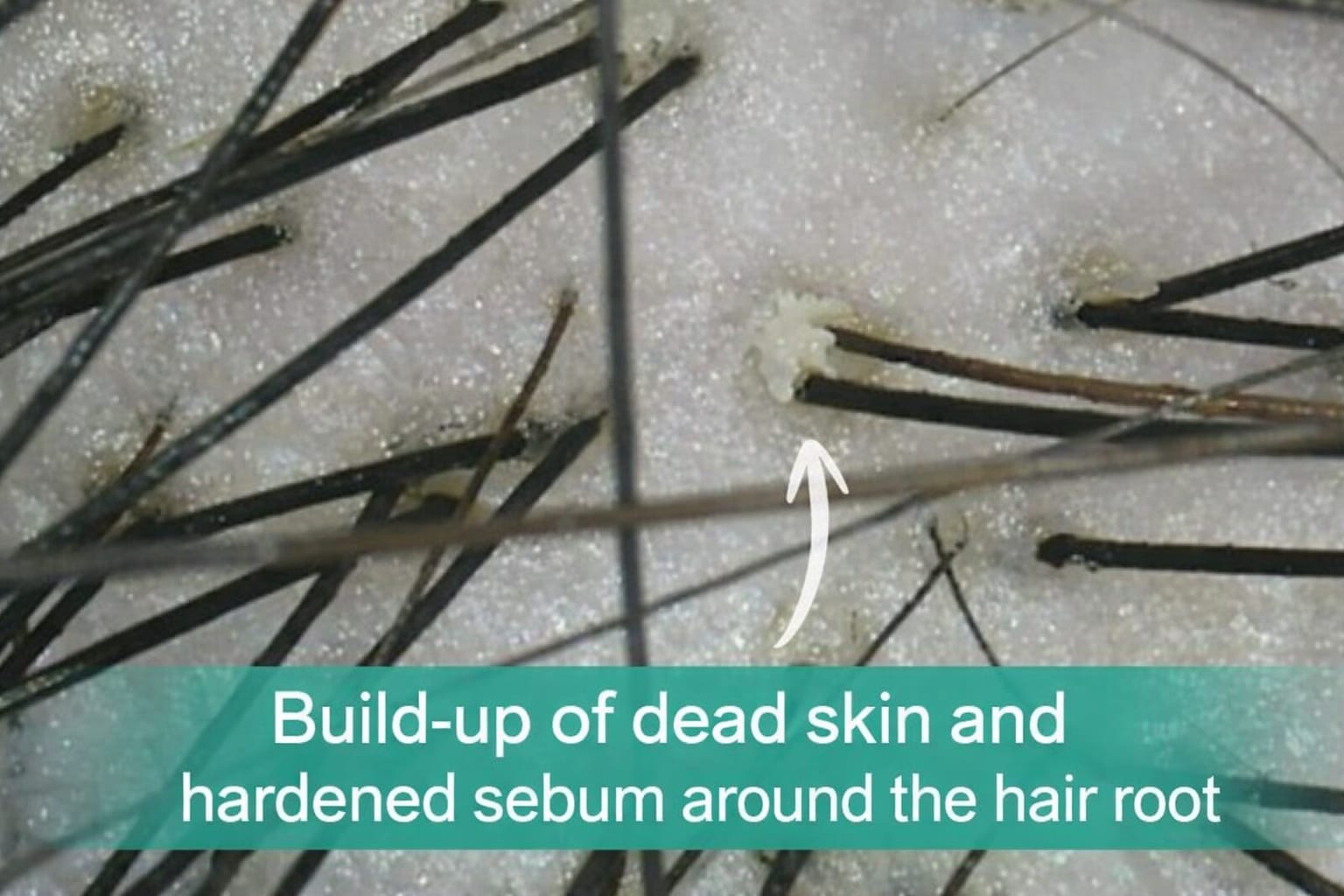
What the professional scalp analysis camera reveals. Most clients have never seen their own scalp at this level of detail before.
What’s Actually Throwing Your Scalp Off
Four things come up again and again with my Vancouver clients.
Urban Air & Pollution
Vancouver is a genuinely beautiful city, but city air carries fine dust and particles that settle onto the scalp and gradually build up around hair follicles. It happens slowly and invisibly — which is exactly why it gets overlooked.
Stress
This is the single biggest factor for most of my clients, and I don’t say that lightly. Prolonged stress disrupts hormonal balance, which triggers the scalp to overproduce sebum — leading to clogged follicles and inflammation. If your scalp has been acting up during a difficult stretch at work, there’s a real, biological reason for that.
How You’re Cleansing
Both extremes cause problems. Too little washing allows oil and dead skin to accumulate and block pores. Too much — especially with the wrong shampoo for your scalp type — strips the natural protective barrier, and the scalp responds by producing even more oil. One mistake makes things greasy; the other makes things reactive.
Chemical Residue from Treatments
Colouring, bleaching, and perming are perfectly safe when done right. The problem arises when chemical residue accumulates on the scalp over time without proper care between treatments. That buildup disrupts the follicle environment and can cause ongoing irritation that’s easy to mistake for general sensitivity.
What a Healthy Scalp Actually Looks Like
If you’ve never seen your own scalp under a magnification camera — which we use before every scalp treatment at our Vancouver salon — the image is usually surprising.
A genuinely healthy scalp has three clear characteristics:
- ✦ Clear, unobstructed follicle openings — no visible buildup around the rim. Each follicle can breathe and receive the nutrients it needs without obstruction.
- ✦ Smooth surface with a subtle shine — like the surface of fresh jelly. This tells us the scalp’s moisture barrier is intact and functioning as it should.
- ✦ 2 to 3 hairs growing from each follicle — a reliable signal of healthy follicle density and adequate nourishment reaching the root.
When clients see their own scalp on camera for the first time, reactions vary. Some are relieved. Many are surprised. A few are quite unsettled. But everyone walks away knowing something they didn’t before — and that knowledge almost always changes how they approach their hair care.
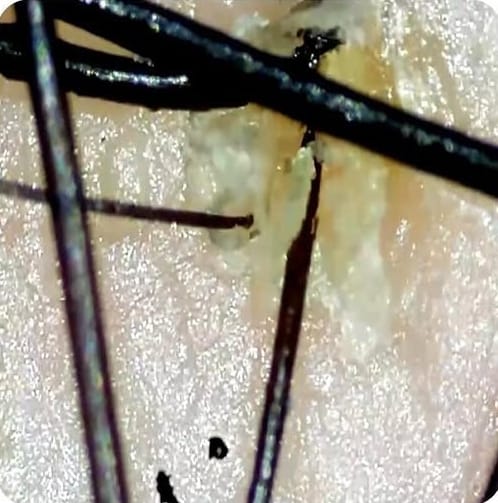

Scalp analysis imagery showing accumulated dead skin cells and hardened sebum around hair follicle openings — the kind of buildup that starts silently and compounds over time.
What Happens When Follicles Get Blocked
When dead skin cells and hardened sebum accumulate around the follicle opening, a chain reaction begins — and it’s one that happens slowly enough that most people don’t connect the dots until they look back at old photos.
Each follicle depends on a steady supply of oxygen and nutrients delivered through the bloodstream. A blocked opening compromises that supply from the very first stage.
Less circulation means less nourishment delivered at the root level — and the hair produced by that follicle reflects that deficit over time.
The change is incremental — which is why it’s so often dismissed as “just ageing” rather than something addressable.
I want to be clear: not all thinning is caused by scalp buildup, and I would never over-diagnose in a salon setting. Hair loss has many causes — some medical, some genetic. But among clients who notice gradual, unexplained thinning and have been told nothing is clinically wrong, improving scalp health has made a visible difference more often than not.
The Fact About Scalp Aging That Nobody Mentions
Here’s something that surprises almost every client when I bring it up:
6× Faster
Your scalp ages approximately 6 times faster than your facial skin — and around 12 times faster than the skin on your body.
Sit with that for a moment. Most of us invest real time and money into facial skincare — moisturisers, serums, SPF, retinol. Entire routines dedicated to keeping that skin healthy and resilient. And yet the skin on top of our heads, ageing at six times that rate, often receives nothing but a quick shampoo and a rinse.
The effects of scalp ageing accumulate quietly, then compound:
- → Hair becomes progressively finer and less dense
- → Grey hairs appear earlier than expected
- → The scalp begins to feel tighter and less supple
- → Circulation decreases, reducing the nutrients that reach every follicle
None of this is inevitable. But like any ageing process, the earlier you start paying attention, the better positioned you are to slow it down.
Scalp Questions I Get Asked Every Week
These are the questions I hear most often from Vancouver clients. I’ve answered each of them hundreds of times — and the answer is rarely what people expect.
Why does my scalp still feel itchy after washing?
Persistent itchiness after washing is rarely just dryness. The real causes vary — seasonal changes, stress-related hormonal shifts, using a shampoo that’s mismatched with your scalp type, or low-grade bacterial activity causing mild inflammation. The most counterproductive response I see is reaching for a stronger “clarifying” formula hoping it’ll fix things. It usually makes the cycle worse by stripping the scalp further.
Why is my hair oily just a few hours after I wash it?
One of three things is typically happening: your shampoo isn’t right for your scalp type, you’re not washing thoroughly enough (we all rush through it), or your scalp has been over-stripped so many times that it’s now producing excess oil in self-defence. The fix here isn’t more frequent washing — it’s understanding what’s driving the imbalance and adjusting accordingly.
Is dandruff always the same condition?
No — and this distinction matters enormously. Dry dandruff produces fine, white flakes linked to insufficient scalp moisture. Oily dandruff tends to appear yellowish and clumpier, and is associated with excess sebum. Using the wrong treatment for the wrong type is extremely common, and it doesn’t just fail to help — it can actively make either condition worse.
Is it bad to wash my hair every day?
My honest answer: it depends. The equation isn’t just about frequency — it’s frequency plus your scalp type plus the specific formula you’re washing with. An oily scalp paired with a gentle, scalp-appropriate shampoo can handle daily washing without issue. That same frequency with a strong clarifying formula on a dry scalp is a reliable recipe for irritation. There’s no universal rule that applies to everyone, but there is always a right answer for your specific scalp.
The Best Starting Point Is Actually Seeing Your Scalp
Generic advice — “use this shampoo,” “wash every other day,” “try a scalp scrub” — rarely sticks because it ignores what makes your scalp different from the person next to you. There’s no one-size-fits-all here.
At Salon Era in Vancouver, every scalp treatment begins with a proper scalp analysis so we can actually see what’s happening at the follicle level before we start. The treatment that follows is targeted rather than guessed at — and the results tend to be far more meaningful as a result.
If you’ve been managing persistent itchiness, oiliness, or early thinning for a while — and nothing you’ve tried has made a lasting difference — a proper scalp analysis might be the most useful appointment you book this year.